Home
About Us
Products
Process Models
SE Resources
Commentary
Contact us
|
|
|
Breaking News!
A new blog ...
Family Guy Stella -
Furthermore, Stella subverts the show’s typical treatment of female characters. Unlike Lois Griffin, who is often reduced to a shrill nag or the victim of Peter’s callousness, or the overtly sexualized and vapid Tricia Takanawa, Stella possesses a quiet authority and emotional intelligence. She is rarely the butt of the joke; instead, she is frequently the one who sees through absurd situations. For instance, when Cleveland becomes obsessed with a ludicrous hobby or conspiracy, Stella is the voice that gently (or firmly) redirects him. This dynamic presents a rare depiction of a healthy, functional marriage within Family Guy ’s rogues’ gallery of dysfunctional relationships. Her patience is not born of weakness but of a pragmatic understanding of her husband’s eccentricities, offering a subtle critique of the show’s more cynical belief that all long-term relationships are inherently miserable.
In the chaotic, cutaway-driven universe of Family Guy , where a talking dog plots against his owner and a baby schemes for world domination, character depth is often sacrificed for the immediate laugh. Most residents of Quahog, Rhode Island, function as two-dimensional archetypes or vessels for absurdist gags. Yet, within this landscape of deliberate nihilism, the character of Stella—the wife of Cleveland Brown and later a recurring figure in her own right—emerges as a surprisingly complex and vital figure. While often relegated to the role of the “straight man,” Stella serves as a crucial narrative anchor, grounding the show’s surrealism in recognizable domestic reality and challenging its cynical worldview through quiet resilience. family guy stella
Beyond her role as a stabilizing wife, Stella’s character evolution—particularly her expanded role in The Cleveland Show and subsequent return to Family Guy —highlights themes of quiet resilience and reinvention. After her divorce from Cleveland (a narrative event handled with surprising emotional gravity), she does not crumble or become a punchline. She continues to work, raise her son, and navigate life in Quahog with the same unshakeable composure. Her later, more independent appearances demonstrate that her identity is not solely defined by her marriage. In a show where characters rarely learn from their mistakes or experience genuine growth, Stella’s ability to adapt and endure marks her as an anomaly. She represents a form of maturity that the show’s core characters—Peter, Lois, Joe, Quagmire—actively reject. She is the quiet adult in the room full of screaming children. For instance, when Cleveland becomes obsessed with a
Stella’s primary function is that of the stabilizing domestic force. In her original run as Cleveland’s wife, she provides a counterbalance to the manic energy of Peter Griffin and his friends. While Peter schemes to steal Cleveland’s “Giggitty” pudding or Lois despairs over her family’s latest disaster, Stella is often found managing the household, working a stable job (as a pharmacist), or dispensing common-sense advice. She is the unflappable core of the Brown household. This role is essential to the show’s comedic rhythm; her exasperated sighs and weary glances at the camera are not merely jokes but necessary releases of tension. Without Stella to represent the normal, functional adult world, the antics of Peter and his cohort would lose their transgressive edge. She is the straight line to their punchline, the canvas that makes their bright, chaotic colors visible. In the chaotic, cutaway-driven universe of Family Guy
In conclusion, Stella is far more than a secondary character or a mere foil for Cleveland Brown. She is the unspoken anchor of Family Guy ’s social ecosystem. By providing a consistent voice of reason, subverting the show’s reductive portrayal of women, and embodying a quiet resilience, she allows the chaos of Quahog to flourish without becoming utterly meaningless. In a series built on the premise that nothing matters, Stella insists, through her very presence, that some things—stability, patience, and quiet dignity—still do. She is the straight-faced heart of a show that often pretends not to have one, and for that, she remains one of its most indispensable figures. |
|
|
|
|
|
|
|
|
|
|
|
|
|
|
| The newest edition! |
|
 |
Another novel by
Roger Pressman! |
|
 |
|
|
|
|
|
Available in trade paperback and e-book editions. For more information, click here. |
|
|
|
|
|
|
|
|
|
|
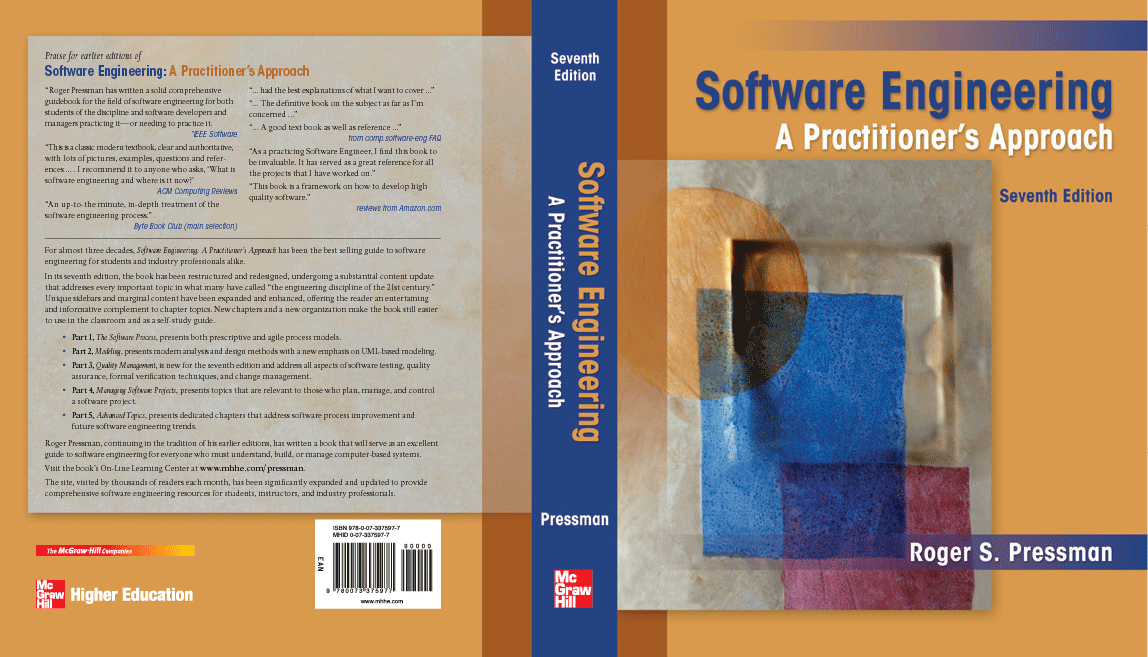
The seventh edition of Software Engineering: A Practitioner's Approach is intended to serve as a guide to a maturing engineering discipline. The seventh edition, like the six editions that preceded it, is intended for both students and practitioners, retaining its appeal as a guide to the industry professional and a comprehensive introduction to the student at the upper level undergraduate or first year graduate level.
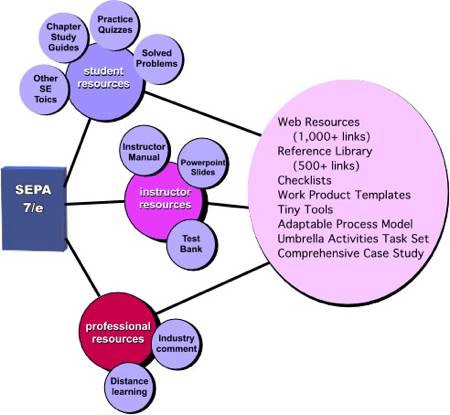
The seventh edition is considerably more than a simple update. The book has been revised and restructured to improve pedagogical flow and emphasize new and important software engineering processes and practices. In addition, a revised and updated “support system,” illustrated below, provides a comprehensive set of student, instructor, and professional resources to complement the content of the book.
|
|
|
|
 |
|
|
The 32 chapters of the seventh edition have been reorganized into five parts. This organization, which differs considerably from the sixth edition, has been done to better compartmentalize topics and assist instructors who may not have the time to complete the entire book in one term.
Part 1, The Process, presents a variety of different views of software process, considering all important process models and addressing the debate between prescriptive and agile process philosophies. Part 2, Modeling, presents analysis and design methods with an emphasis on object-oriented techniques and UML modeling. Pattern-based design and design for Web applications are also considered. Part 3, Quality Management, presents the concepts, procedures, techniques, and methods that enable a software team to assess software quality, review software engineering work products, conduct SQA procedures, and apply an effective testing strategy and tactics. In addition, formal modeling and verification methods are also considered. Part 4, Managing Software Projects, presents topics that are relevant to those who plan, manage, and control a software development project. Part 5, Advanced Topics, considers software process improvement and software engineering trends. Continuing in the tradition of past editions, a series of sidebars is used throughout the book to present the trials and tribulations of a (fictional) software team and to provide supplementary materials about methods and tools that are relevant to chapter topics. Two new appendices provide brief tutorials on UML and object-oriented thinking for those who may be unfamiliar with these important topics.
The five-part organization of the seventh edition enables an instructor to "cluster" topics based on available time and student need. An entire one-term course can be built around one or more of the five parts. A software engineering survey course would select chapters from all five parts. A software engineering course that emphasizes analysis and design would select topics from Parts 1 and 2. A testing-oriented software engineering course would select topics from Parts 1 and 3, with a brief foray into Part 2. A "management course" would stress Parts 1 and 4. By organizing the seventh edition in this way, I have attempted to provide an instructor with a number of teaching options. |
|
|
Software Engineering: A Practitioner's Approach
7th Edition
Table of Contents
Chapters
1. Software and Software Engineering
Part I - Process
2. Process Models
3. Agile Development
Part II - Modeling
4. Practice: A Generic View
5. Understanding Requirements (new chapter)
6. Requirements Modeling: Scenarios and Data (new chapter)
7. Requirements Modeling: Flow, Classes, and Behavior (new chapter)
8. Design Concepts (new chapter)
9. Architectural Design
10. Component-Level Design
11. Usability design (new chapter)
12. Pattern-based Design (new chapter)
13. WebApp Design
Part III - Quality Management
14. Quality Concepts (new chapter)
15. Software reviews (new chapter)
16. Software Quality Assurance
17. Software Testing Strategies
18. Testing Methods for Conventional Software (new chapter)
19. Testing Methods for OO Software (new chapter)
20. Testing Methods for WebApps
21. Advanced Verification Methods (new chapter)
22. Software Configuration Management
23. Product Metrics
Part IV - Project Management
24. Management Concepts
25. Process and Project Metrics
26. Estimation
27. Scheduling
28. Risk Management
29. Maintenance and Reengineering (new chapter)
Part V-Advanced Topics
30. Software Process improvement (new chapter)
31. Emerging Trends in Software Engineering (new chapter)
32. The Road Ahead
Appendix I - UML Tutorial (new)
Appendix II - OO Concepts (new)
|
|
|
|
|
|
|
|
|
Home About us Products Product Models SE Resources Commentary Contact us
Web site and all contents © 2001-2009, R.S. Pressman & Associates, Inc., All rights reserved.
Free website templates
|
|